Evidence-Gated Alignment at Inference Time
What Is a Human Interaction Profile (HIP)?
A Human Interaction Profile (HIP) is a permissioned, structured alignment artifact injected at inference time to provide user-scoped context to an LLM without modifying the model or retaining long-term memory.
HIP treats misalignment as a systems problem, not a prompt-writing problem.
- No user memory
- No fine-tuning
- No identity inference
- Not an HR tool
How HIP Works (Architecture)
HIP is injected per request and optionally gates evidence retrieval.
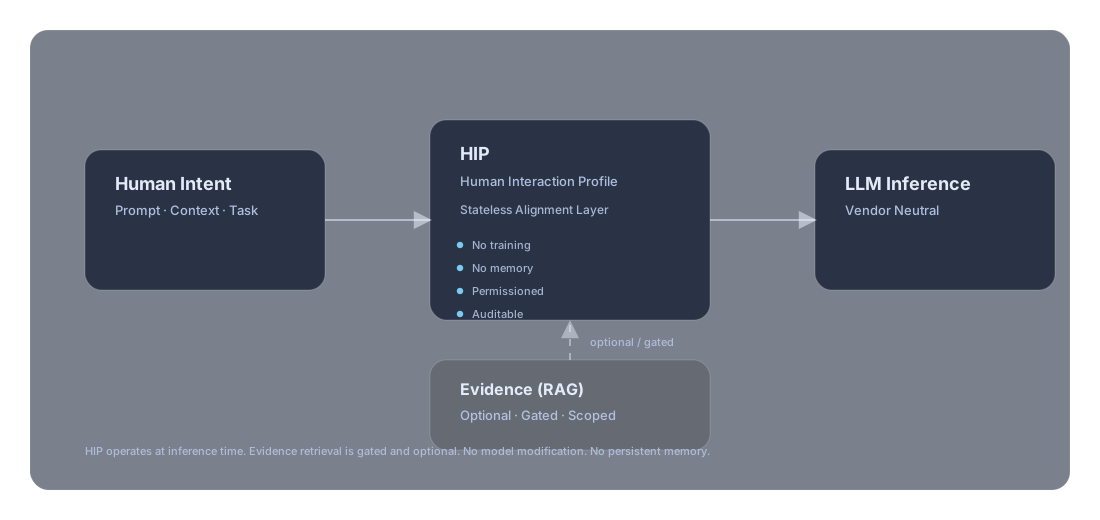
HIP operates at inference time without modifying the model or retaining memory.
What the POC Measures
This POC isolates alignment impact, not model intelligence.
- Align scope + success criteria
- Run A/B with HIP
- Review results + rollout decision
Why This Is Safe to Pilot
- No model retraining
- No persistent memory
- Auditable + permissioned
- Easy rollback
Talk to us about a POC
Or email hip@traingle.ai
Architecture FAQ
Is this prompt engineering?
No. HIP does not rely on handcrafted prompts or prompt chaining. It injects a structured, permissioned context artifact at inference time. The model is not guided by clever phrasing, but by explicit, machine-readable alignment inputs.
Is this just RAG?
No. Retrieval is optional and gated. HIP operates even without retrieval. When RAG is used, it is subordinate to alignment — evidence is retrieved only when required, not blindly appended to prompts.
Is HIP a form of memory or user profiling?
No. HIP is stateless by design. No user memory is persisted unless explicitly implemented by the host system. HIP does not infer traits, build profiles, or track behavior over time.
Does HIP require fine-tuning or model retraining?
No. HIP operates entirely at inference time. Models are not modified, retrained, or specialized. This keeps HIP vendor-neutral and low risk.
How is this different from personalization?
Personalization adapts output based on inferred user preferences. HIP aligns interaction behavior using explicitly provided context and constraints. It is alignment infrastructure, not preference optimization.
Where does HIP run in the stack?
HIP runs between the user input layer and model inference. It does not replace orchestration, RAG pipelines, or application logic — it augments them.
Can HIP be audited or removed?
Yes. HIP inputs are explicit and auditable. The layer can be removed without downstream impact, leaving the underlying system unchanged.
What does the POC actually validate?
The POC validates whether inference-time alignment reduces refusals, clarification loops, and human intervention — without reducing answerability or increasing risk.
Security & Governance (POC Scope)
HIP is designed to align with common enterprise security, privacy, and governance expectations, particularly during proof-of-concept evaluations.
Data handling
HIP does not require persistent storage of user data. Any context provided to HIP is scoped to the
active request unless the host system explicitly chooses to store it.
Stateless operation
HIP operates without long-term memory by default. No behavioral history, preference tracking,
or inferred profiles are retained by the HIP layer.
Consent and scope
HIP relies on explicitly provided context. Inputs are permissioned by the host application and can
be limited by role, task, or environment.
Auditability
HIP inputs are structured and explicit, making them inspectable and auditable. The host system
controls what context is injected and can log or review these inputs as needed.
Model and vendor isolation
HIP does not modify models, weights, or training data. It remains vendor-neutral and does not
introduce model lock-in.
Removal and rollback
The HIP layer can be removed without downstream impact. Removing HIP returns the system to its
original behavior with no residual state.
This appendix describes default POC behavior. Production deployments may apply additional controls based on organizational policy and regulatory requirements.